How Many People Don't Read in America
Stop Wasting COVID Tests, People
With the surge in cases, tests should be reserved for those who need them virtually.
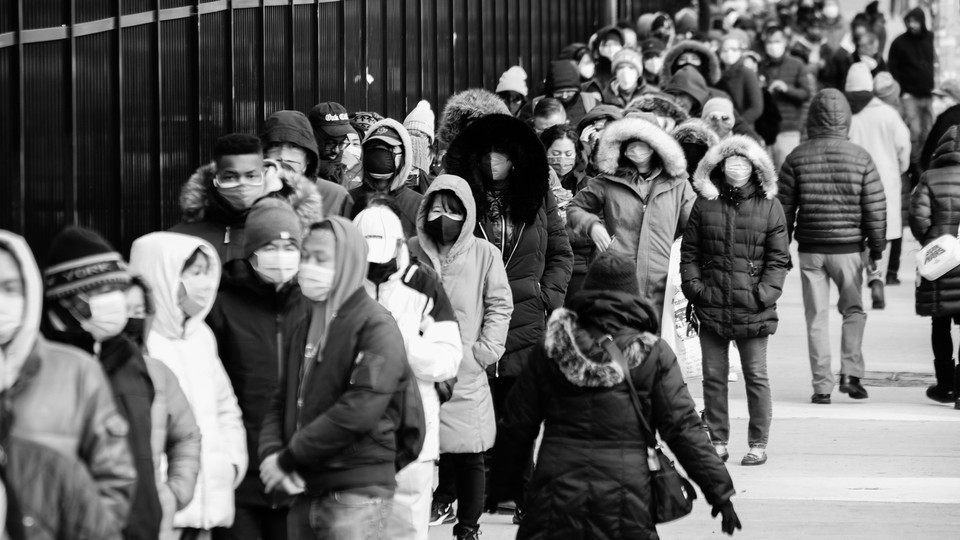
Motility over mimosas, because America has a fresh New Yr'southward tradition: struggling to get tested for COVID before returning to school or work. The line for brunch was replaced, last weekend, with line later line afterward line of weary citizens waiting to receive their viral clearance. Testing backlogs are only going to get worse from here, as example numbers go along their ascent. Merely among the complaints about a lack of rapid-testing kits and long delays for lab results, I'm reminded of the aphorism "You lot are not stuck in traffic. You are traffic." Yes, the system failed us: Inadequate public investment in the nation's testing infrastructure has worsened the congestion. Merely we can assist ease it too—and clear the way for those who have the greatest need for their results—by staying off the route whenever possible.
Afterwards weeks of bad press, the authorities is at present trying to intervene more aggressively. "I know you're tired, really, and I know you're frustrated," President Joe Biden said before the holidays, announcing that his administration would requite abroad 500 meg rapid tests starting in Jan. But even if this does better the testing traffic somewhat, information technology won't resolve our national shortage. At the time of Biden's argument, the authorities hadn't actually finalized the contracts for the massive purchase. Newly authorized at-home tests from Roche and Siemens will besides launch in Jan, even so their supply will number only in the "tens of millions," at least at commencement. As for laboratory testing, the near-term prospects may be even dimmer: PCR engineering science cannot scale as readily as simple antigen tests. Over the past two years, labs take worked effectually the clock to offer millions of PCR assays daily, but further expansion has been hampered past global supply-concatenation disruptions and a long-simmering staffing crisis.
It'southward possible to feel outrage at this state of affairs while behaving as responsibly equally possible, given the circumstances. This is the testing version of vaccine equity: the endeavor to ensure that life-saving inoculations don't unduly benefit the healthiest and wealthiest people. When the same principle is practical to diagnostics, it means that people at the lowest run a risk from COVID shouldn't buy up big stocks of at-home tests, or grab PCR appointments when they're non experiencing symptoms.
Many of those queuing up for tests this week have piddling choice nigh the matter; negative results can be required for travel or school or access to public venues. But other types of COVID screening—before and after family gatherings, for instance, or while visiting nearby vacation destinations—are optional. It might seem reckless to suggest that people undergo less surveillance; indeed, the standard expert's have has been the opposite, that nosotros all should screen ourselves equally often every bit possible in social club to help reduce customs spread. But fifty-fifty with increased testing, we stand up niggling adventure of controlling Omicron this wintertime at the population level. And testing is, for now, a zero-sum game. Each unnecessary swab that you swallow means one fewer is available for more important purposes—such as diagnosing a symptomatic infection.
We've reached a bespeak in the pandemic where diagnostic testing is medically essential. The FDA recently authorized two antiviral pills to care for early COVID infections: Paxlovid and Molnupiravir. Paxlovid, the more effective of the two, can prevent upward to 88 per centum of hospitalizations or deaths in people who start taking it within five days of symptom onset. A more familiar treatment, remdesivir, can also help prevent severe outcomes—but it works best when it'southward given early in the illness. In other words, it's never been more of import for vulnerable patients to know, as shortly as possible, that they're infected. Sick patients who struggle to obtain an at-domicile test or have to wait days for a laboratory result might find themselves ineligible for time-sensitive but life-saving interventions, Walid Gellad, a professor of medicine at the University of Pittsburgh, told me. We don't want our limited testing supply "tied up by people who just want to know so they tin can visit their friends or get to the opera."
Everyone should practise what they can to free testing resources for those with symptoms. We should too try to allocate tests based on underlying risks. The unvaccinated are, overall, most in danger of being hospitalized and dying from the virus, then they are too, overall, the people who benefit the most from having those around them screened for infection. Social bubbles being what they are, I suspect that many people with arsenals of at-home tests spend much of their personal fourth dimension around other vaccinated and relatively depression-risk individuals, making the public-wellness benefits of their personal screening programs marginal at best.
Two major categories of people remain at serious risk of dying from COVID despite vaccination: the elderly and immunocompromised. Older people and those with severe immune-system deficiencies will quite reasonably take actress precautions while socializing—including request their shut contacts to make prodigious utilise of rapid tests. Outside of nursing homes, though, there has been little effort in the U.Southward. to prioritize diagnostic access for these groups. Instead, we face an bad-mannered situation where many universities are performing thousands of tests a 24-hour interval on young, vaccinated, and largely healthy student populations while loftier-risk individuals and their caregivers struggle to keep up with surveillance. Well-heeled companies similar Google are even sending employees—many of whom are still working from home—some of the about sophisticated COVID-detection tools on the market. "The worried, wealthy well are doing lots of tests of uncertain value," the epidemiologist Daniel Morgan of the University of Maryland told me, while "the turnaround time is bravado up for college-value uses."
It's true that testing low-run a risk people tin break infection chains that eventually reach the more vulnerable, but this will exist of little consolation to susceptible community members who can't even ensure that their directly contacts have been cleared of infection. In curt, you might consider testing your kids before they visit Grandma, only checking them after every fleeting or outdoor interaction with someone who may take been infected offers marginal benefit. And if we really desire to be serious about test equity, universities and corporations should donate their diagnostic capacity to nursing homes and caregivers of high-risk individuals. Health-care providers, schools, and employers might likewise forgo asking for PCR confirmation when someone has already proved positive by rapid test, at least while infections are so rampant.
Public-health experts could be leading this charge and modeling diagnostic thriftiness. Instead, many have modeled something else entirely, using social media to display their own improvident consumption. I've watched my doctor colleagues tweet out photos of their private stockpiles of rapid antigen tests, allowing them to check their families daily while on vacation. Medical influencers take noble motives for sharing their ambitious COVID surveillance strategies, but given the famine of supplies, their messaging comes off as far less useful than they remember. "There are 2 pandemics: 1 iv the wealthy & one 4 the poor," tweeted the physician and journalist Elisabeth Rosenthal, who admitted to being "weirded out" by these gaudy displays of test abundance. She'south right: It'due south a nice idea, in theory, to show how frequent testing could be used to protect your family and customs. In practice, we should be leaving tests on shelves for other people.
I will admit to being as cocky-interested equally whatever other homo. Despite recognizing the demand for vaccine and examination equity, I received three Pfizer shots as shortly as I was eligible, and I've kept a stash of rapid-detection kits in my cupboard. Simply my ain cognitive dissonance, and that of other privileged people, has become untenable in the face of Omicron'due south case surge. Given the reality of our testing shortages, it's time nosotros started cutting back, where and when nosotros can.
Source: https://www.theatlantic.com/health/archive/2022/01/covid-test-shortage/621149/
0 Response to "How Many People Don't Read in America"
إرسال تعليق