Again and Again and Again Anne Sexton Reading
x Poems by Anne Sexton, Confessional Poet
By | On | Comments (iii)

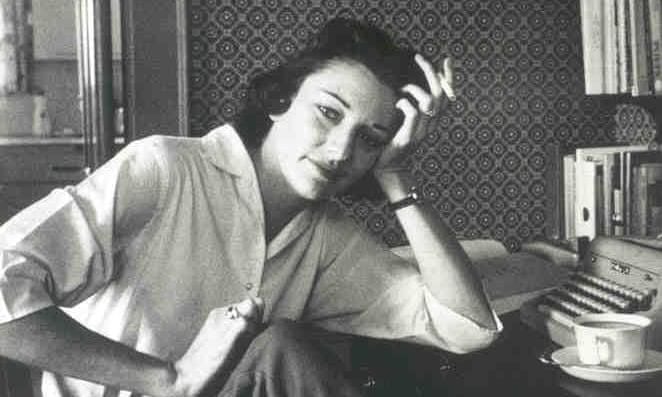
Anne Sexton (1928 – 1974) proclaimed that she was "the merely confessional poet" some time before taking her own life at the age of forty-five. Following is a sampling of 10 poems by Anne Sexton, as circuitous and talented an artist as they come up.
Her skilful friend Sylvia Plath, whose poetry stands squarely in the realm of the confessional movement, might take taken issue with that. Anne felt a bang-up kinship with Plath, and like her, ofttimes expressed a death wish in her poems.
Here are the poems you'll find in this mail service:
- A Curse Against Elegies
- Again and Once more and Once again
- The Ambition Bird
- Wanting to Dice
- More than Myself
- The Fury of Sunsets
- Her Kind
- Barefoot
- Blood-red Roses
- 45 Mercy Street
This excellent overview analysis of Sexton's body of work is highly recommended if you're just getting acquainted with her work. It begins:
"A college dropout turned housewife, way model, and jazz singer, Anne Grey Harvey Sexton is an unusual source of self-revelatory verse that prefaced an era of modernist confessional.
An ambivalent feminist, she spoke for the turmoil in women who despised the housewife'south boring fate, yet she suffered guilt over ventures into aroused complaint and personal freedom.
A relentlessly honest observer capable of springing from disillusion to flashes of perception, she celebrated physical details of womanhood … Long parted from organized religion, she retained the mistake-consciousness and self-loathing of Roman Catholicism."
From the time she started writing poetry as a fashion to recover from a mental breakdown, her writing and her inner life were joined.
Anne likely suffered from bipolar disorder, then chosen manic low. Every bit she struggled to come to terms with her mental illness, her therapist suggested that she begin to write.
Joining some Boston-area writing groups was fortuitous. Anne continued with established poets similar Maxine Kumin, who became a lifelong friend. The 2 women regularly critiqued one another's poetry and wrote four children'south books together.
Anne also studied with Robert Lowell and George Starbuck. Learn more about the trajectory of her writing career and growth equally a poet in our biography of Anne Sexton. From that synergy emerged a period of wild creativity that resulted in more than a dozen collections and a Pulitzer Prize.
The art of confessional verse
In an analysis of Sexton inside the genre of confessional poesy, Dr. Ruwayda Jassim Muhammad offers these observations :
"The events of Sexton'southward life are revealed in her poems — her breakdown, time in a mental infirmary, her therapy, her troubled union (ending in divorce, her affairs, and her relationship with her two daughters became transparently the stuff of her poesy, and her poesy became far more direct than that of Robert Lowell or Sylvia Plath as confessional poetry.
… Dianne Middlebrook defined characteristics and distinctive voice that is understood to be the voice of the poet himself or herself, writing: 'Its principle themes are divorce, sexual infidelity, childhood, neglect and the mental disorders that follow from deep emotional wounds received early in life.
A confessional poem contains the kickoff-person speaker, and e'er seems to refer to a real person in whose bodily life real episodes accept occurred that cause actual pain, all represented in the poem.
Yet, her poetry should not be regarded as a mere recording of her experiences — in a essay on both To Bedlam and Role Way Back (1960) and All My Pretty Ones (1962), Beverly Fields argued that Sexton's poetry is mostly misread; she argued that the poems are not as autobiographical every bit they seem — that they are poems, not memoirs.
She went on to clarify many of them in depth in order to evidence the recurrent symbolic themes and poetic techniques she felt made Sexton's work impressive.
… Most critics agree on the fact that Sexton wrote about wanting to die … from a very personal point of view. According to Diane Hume George, in that location are 'at to the lowest degree twenty poems primarily explaining what it feels like to want, or need, to die …
She viewed expiry as a state which exists in life; it is 'here,' i.e., in life and all the time; so to her, expiry and life are inseparable."
Encounter many more of Anne Sexton's most iconic poems at Poetry Foundation. All poems may be found in Anne Sexton: The Complete Poems, 1981
. . . . . . . . . .
A Curse Against Elegies
Oh, dearest, why practise nosotros argue similar this?
I am tired of all your pious talk.
Also, I am tired of all the dead.
They refuse to mind,
so leave them alone.
Accept your human foot out of the graveyard,
they are busy beingness expressionless.
Everyone was ever to blame:
the final empty 5th of booze,
the rusty nails and chicken feathers
that stuck in the mud on the back doorstep,
the worms that lived under the cat'south ear
and the thin-lipped preacher
who refused to call
except once on a flea-ridden 24-hour interval
when he came scuffing in through the 1000
looking for a scapegoat.
I hid in the kitchen under the ragbag.
I decline to remember the expressionless.
And the expressionless are bored with the whole thing.
But you — you become ahead,
get on, keep dorsum down
into the graveyard,
lie down where you call back their faces are;
talk back to your old bad dreams.
Analysis of "A Curse Against Elegies"
. . . . . . . . . .

. . . . . . . . . .
Again and Over again and Again
You said the acrimony would come up dorsum
just as the love did.
I have a blackness wait I practise not
like. It is a mask I effort on.
I drift toward it and its frog
sits on my lips and defecates.
Information technology is old. It is besides a pauper.
I have tried to go on information technology on a diet.
I give it no unction.
There is a good look that I clothing
like a blood clot. I take
sewn it over my left breast.
I take made a vocation of it.
Lust has taken plant in it
and I accept placed you and your
child at its milk tip.
Oh the blackness is murderous
and the milk tip is chock
and each machine is working
and I volition kiss y'all when
I cut upwards ane dozen new men
and you lot will die somewhat,
again and again.
Analysis of "Again and Again and Again"
. . . . . . . . . .
. . . . . . . . . .
The Ambition Bird
And then it has come up to this –
insomnia at 3:fifteen A.Thousand.,
the clock tolling its engine
like a frog following
a sundial yet having an electric
seizure at the quarter hour.
The business organisation of words keeps me awake.
I am drinking cocoa,
the warm brown mama.
I would like a unproblematic life
even so all nighttime I am laying
poems away in a long box.
It is my immortality box,
my lay-abroad plan,
my coffin.
All night nighttime wings
flopping in my heart.
Each an ambition bird.
The bird wants to be dropped
from a high place like Tallahatchie Bridge.
He wants to light a kitchen match
and immolate himself.
He wants to fly into the hand of Michelangelo
and come out painted on a ceiling.
He wants to pierce the hornet's nest
and come out with a long godhead.
He wants to accept breadstuff and wine
and bring forth a man happily floating in the Caribbean.
He wants to be pressed out like a cardinal
so he can unlock the Magi.
He wants to take leave amid strangers
passing out bits of his heart similar hors d'oeuvres.
He wants to dice irresolute his clothes
and commodities for the sunday similar a diamond.
He wants, I want.
Dear God, wouldn't it be
good enough just to drink cocoa?
I must get a new bird
and a new immortality box.
In that location is folly plenty inside this one.
Analysis of 'The Ambition Bird"
. . . . . . . . . .
Wanting to Die (1981)
Since you ask, nearly days I cannot retrieve.
I walk in my vesture, unmarked by that voyage.
Then the almost unnameable lust returns.
Even then I accept zip confronting life.
I know well the grass blades you mention,
the furniture you accept placed under the sun.
But suicides have a special language.
Like carpenters they want to knowwhich tools.
They never askwhy build.
Twice I have then simply declared myself,
have possessed the enemy, eaten the enemy,
have taken on his arts and crafts, his magic.
In this way, heavy and thoughtful,
warmer than oil or h2o,
I have rested, drooling at the mouth-hole.
I did non remember of my body at needle point.
Even the cornea and the leftover urine were gone.
Suicides accept already betrayed the body.
Still-born, they don't always die,
only dazzled, they can't forget a drug so sweet
that even children would look on and smile.
To thrust all that life nether your natural language!–
that, all by itself, becomes a passion.
Decease's a sad Bone; bruised, you'd say,
and however she waits for me, year after year,
to so delicately undo an old wound,
to empty my breath from its bad prison.
Balanced there, suicides sometimes run into,
raging at the fruit, a pumped-up moon,
leaving the bread they mistook for a kiss,
leaving the page of the volume carelessly open,
something unsaid, the phone off the claw
and the beloved, whatsoever it was, an infection.
Analysis of "Wanting to Die"
. . . . . . . . . .

Anne Sexton on Bookshop.org *
Anne Sexton page on Amazon*
. . . . . . . . . .
More Than Myself
Not that it was cute,
merely that, in the end, in that location was
a certain sense of order there;
something worth learning
in that narrow diary of my mind,
in the commonplaces of the aviary
where the cracked mirror
or my own selfish death
outstared me . . .
I tapped my ain head;
it was drinking glass, an inverted basin.
It's small thing
to rage inside your own bowl.
At beginning it was private.
So it was more than myself.
. . . . . . . . . .
The Fury Of Sunsets
Something
cold is in the air,
an aura of ice
and phlegm.
All 24-hour interval I've built
a lifetime and now
the sun sinks to
undo it.
The horizon bleeds
and sucks its pollex.
The little red thumb
goes out of sight.
And I wonder about
this lifetime with myself,
this dream I'm living.
I could eat the sky
like an apple
but I'd rather
ask the offset star:
why am I here?
why do I live in this business firm?
who's responsible?
eh?
Analysis of the Fury sequence, of which this poem is function.
. . . . . . . . . .
Her Kind
I take gone out, a possessed witch,
haunting the blackness air, braver at night;
dreaming evil, I accept done my hitch
over the evidently houses, light by light:
lone affair, twelve-fingered, out of mind.
A adult female similar that is not a woman, quite.
I have been her kind.
I accept found the warm caves in the wood,
filled them with skillets, carvings, shelves,
closets, silks, innumerable appurtenances;
stock-still the suppers for the worms and the elves:
whining, rearranging the disaligned.
A adult female like that is misunderstood.
I have been her kind.
I accept ridden in your cart, driver,
waved my nude arms at villages going past,
learning the final bright routes, survivor
where your flames still seize with teeth my thigh
and my ribs crack where your wheels wind.
A woman similar that is not aback to die.
I have been her kind.
Assay of "Her Kind"
. . . . . . . . . .
Barefoot
Loving me with my shoes off
means loving my long brownish legs,
sweet dears, equally good equally spoons;
and my feet, those 2 children
permit out to play naked. Intricate nubs,
my toes. No longer bound.
And what's more, see toenails and
all ten stages, root by root.
All spirited and wild, this little
piggy went to market and this little piggy
stayed. Long brownish legs and long chocolate-brown toes.
Farther up, my darling, the woman
is calling her secrets, little houses,
niggling tongues that tell yous.
There is no one else but us
in this business firm on the land spit.
The ocean wears a bell in its navel.
And I'm your barefoot wench for a
whole calendar week. Do y'all care for salami?
No. Yous'd rather not have a scotch?
No. You don't really drink. Y'all do
beverage me. The gulls kill fish,
crying out like three-year-olds.
The surf's a narcotic, calling out,
I am, I am, I am
all dark long. Barefoot,
I pulsate upward and down your back.
In the morning I run from door to door
of the cabin playing chase me.
Now you lot grab me by the ankles.
Now yous piece of work your way upwards the legs
and come up to pierce me at my hunger mark.
. . . . . . . . . .
Red Roses
Tommy is three and when he'south bad
his mother dances with him.
She puts on the record,
"Red Roses for a Blueish Lady"
and throws him across the room.
Mind you lot,
she never laid a mitt on him.
He gets ruby-red roses in dissimilar places,
the head, that time he was every bit sleepy as a river,
the back, that time he was a cleaved scarecrow,
the arm like a diamond had bitten it,
the leg, twisted like a licorice stick,
all the dance they did together,
Blueish Lady and Tommy.
You lot fell, she said, simply retrieve you fell.
I fell, is all he told the doctors
in the large hospital. A nice lady came
and asked him questions but because
he didn't desire to exist sent away he said, I fell.
He never said anything else although he could talk fine.
He never told nigh the music
or how she'd sing and shout
property him upwards and throwing him.
He pretends he is her ball.
He tries to fold upwardly and bounce
simply he squashes like fruit.
For he loves Bluish Lady and the spots
of red roses he gives her.
Analysis of "Scarlet Roses"
. . . . . . . . .
45 Mercy Street (a fragment)
In my dream,
drilling into the marrow
of my entire os,
my existent dream,
I'm walking upwardly and down Beacon Hill
searching for a street sign –
namely MERCY STREET.
Non there.
I try the Back Bay.
Not there.
Not in that location.
And yet I know the number.
45 Mercy Street.
I know the stained-glass window
of the foyer,
the three flights of the house
with its parquet floors.
I know the furniture and
mother, grandmother, dandy-grandmother,
the servants.
I know the cupboard of Spode
the boat of ice, solid silvery,
where the butter sits in cracking squares
like strange behemothic's teeth
on the big mahogany table.
I know it well.
Not in that location.
Where did yous get?
45 Mercy Street,
with nifty-grandmother
kneeling in her whale-bone corset
and praying gently but fiercely
to the wash basin,
at five A.M.
at noon
dozing in her wiggy rocker,
grandfather taking a nap in the pantry,
grandmother pushing the bell for the downstairs maid,
and Nana rocking Mother with an oversized flower
on her forehead to cover the gyre
of when she was good and when she was…
And where she was begat
and in a generation
the third she will beget,
me,
with the stranger's seed blooming
into the flower chosen Horrid.
I walk in a yellowish dress
and a white purse blimp with cigarettes,
enough pills, my wallet, my keys,
and being xx-eight, or is it forty-five?
I walk. I walk.
I concur matches at street signs
for it is nighttime,
as dark every bit the leathery dead
and I have lost my green Ford,
my house in the suburbs,
two little kids
sucked up similar pollen by the bee in me
and a husband
who has wiped off his eyes
in order non to see my within out
and I am walking and looking
and this is no dream
simply my oily life
where the people are alibis
and the street is unfindable for an
entire lifetime.
Pull the shades downwards –
I don't care!
Commodities the door, mercy,
erase the number,
rip down the street sign,
what can information technology matter,
what tin it thing to this cheapskate
who wants to own the by
that went out on a dead ship
and left me only with paper?
Not there.
I open my pocketbook,
every bit women practice,
and fish swim back and forth
betwixt the dollars and the lipstick.
I pick them out,
1 past 1
and throw them at the street signs,
and shoot my pocketbook
into the Charles River.
Next I pull the dream off
and slam into the cement wall
of the clumsy calendar
I live in,
my life,
and its hauled up
notebooks.
Analysis of "45 Mercy Street" (and its influence on Peter Gabriel's "Mercy Street"
. . . . . . . . . .
More about the verse of Anne Sexton
- Poetry Foundation
- Poetry Archive
- Anne Sexton Love Poems
- Anne Sexton and the Poetry of Mental Illness
. . . . . . . . . .
*These are Amazon Affiliate and Bookshop.org links. If the product is purchased by linking through, Literary Ladies Guide receives a pocket-sized commission, which helps maintain our site and helps it to go on growing!
Categories: Poetry
Source: https://www.literaryladiesguide.com/classic-women-authors-poetry/10-poems-by-anne-sexton/
0 Response to "Again and Again and Again Anne Sexton Reading"
إرسال تعليق